
As mentioned in my previous post, there are political and social factors that limit bilingual education from being nationally implemented, as a result, U.S. is falling behind in bilingual education. However, it is not an unsolvable situation. To tackle the problem, it is necessary that efforts are put into changing the ultimate goal of bilingual education, choosing the appropriate model and eliminating hesitation in enrollment due to contradicting research. I will explain why and what exactly to do in the following.

The first step towards successful bilingual education in U.S. is to eliminate the contradiction in the impacts of being bilingual. As I have mentioned before, parents and students are hesitating to take part in bilingual education because there are too many contradicting research on the impact of being bilingual. For instance, in “The Cognitive Benefits of Being Bilingual,” Viorica Marian and Anthony Shook, Chair and a doctoral candidate in the department of communication sciences and disorders at Northwestern University, mention that research show bilingual children can better adjust to environmental changes. While in “Bilinguals Show Weaker Lexical Access During Spoken Sentence Comprehension,” Marian, Shook and Caroline Engstler and Matthew Goldrick from the Department of Linguistics point out that bilinguals “show delays in accessing lexical items relative to monolinguals.” When two credible sources speaks differently about the advantages and disadvantages of being bilingual, confusion occurs and people will have doubt on whether bilingual education is beneficial or not.

If parents are not willing to let their children to enroll in bilingual programs or students do not believe the program will benefit them because of this reason, not matter how good the current policies or program are, bilingual education will not success. Therefore, one solution would be for institutions to conduct in-depth studies and research comparing both advantages and disadvantages on the same page. In this way, the public will have a clear idea to decide their attitude to the bilingual education system. Meanwhile, everyone including parents and potential students in bilingual education should be aware that proficiency has to be considered to give a full picture when concluding whether being bilingual is beneficial. As mentioned in my previous blog “Bilingual: Is having Two Active Language System a Disadvantage?” some disadvantages of being bilingual may be washed away as proficiency goes up.

Another key to ease the problem is resetting the goal. It is crucial to have a consensus that the ultimate goal of bilingual education should not be simply helping non-English speakers assimilate, but to recognize the benefit of bilingual education and make language diversity as the goal. One reason why bilingual education in the U.S. falls behind other countries is that U.S. has a different approach to bilingual education. Here in the U.S., bilingual education is implemented mainly to help immigrants who speak a non-English native language to learn English and improve English proficiency to assimilate. As stated in “Bilingual Education Programs in the United States: For Assimilation or Pluralism?” over 80 percent of the bilingual education in U.S. follows the assimilation model which “teachers are either inactive in ethnic community affairs or active only in conservative elitist ethnic organizations and causes.” This means teachers are not actively showing stable bilingualism and culturalism in the local ethic community. In the assimilation model, one language will be suppressed while the other dominates. As a result, students might lose their first language as they proceed in their second language acquisition.
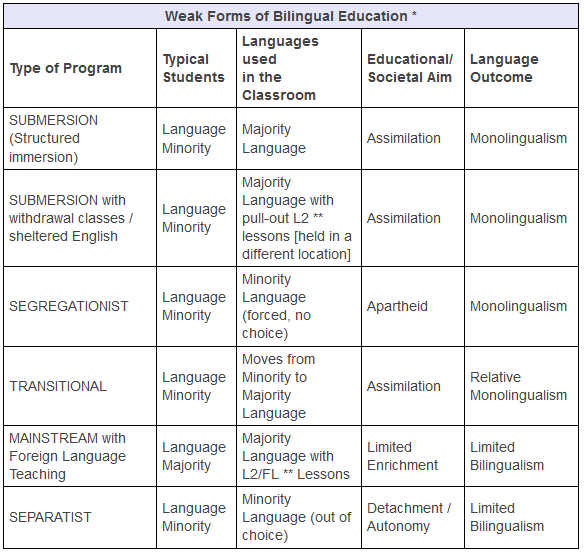
On the other hand, most countries that have relatively successful bilingual education value co-dominance of two languages and follow the pluralistic model. For instance, in “Bilingual Education Program Models: A Framework For Understanding,” Professor Cheryl Roberts from the English department at University of Northern Iowa points out the immersion model developed in and used in Canada is generally pluralistic. In the immersion model, English speakers successfully learn French and become biliterate and bilingual in two languages. Because the two languages are constantly active, it is most likely that the outcome would be additive bilingualism, which students maintain their first language and acquire their second language.
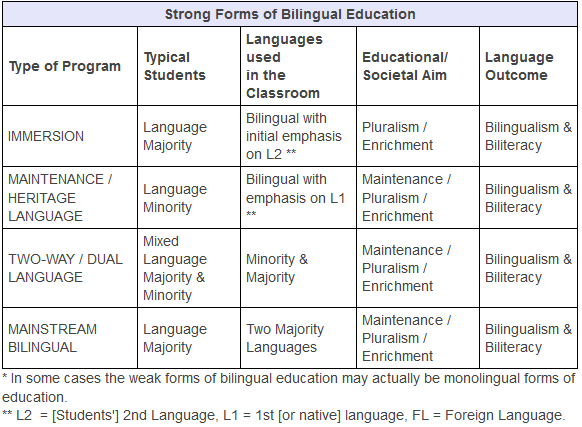
Seeing how the pluralistic approach would give a better outcome, I think U.S. should learn from successful cases, recognize the value of the co-dominance of two languages, and implement bilingual education with bilingualism as goal instead of assimilation. Hence, one way to improve bilingual education is that the government officially replan the whole bilingual education with a new approach.
At the same time, it is crucial that we choosing the right bilingual education model and put it into practice. Indeed, the dual language education model is very effective, as Virginia P. Collier and Wayne P. Thomas from George Mason University conclude in “The Astounding Effectiveness of Dual Language Education for all.” Yet, dual language might not be the best fit for every state. Just like getting a pair of jeans, what it is made of is important but it is not the only factor. We should also consider the size and cutting. When choosing the a bilingual education model, it is important to consider the demographics and the bilingualism status in that particular state. If the state does not have the resources like qualified educators, then dual-language programs might not be the best practice at the beginning of education reform.
In conclusion, bilingual education in U.S, can be better if schools, states, parents and students work hand in hand. With efforts, getting rid of the notorious tag of being “not bilingual enough” is possible.
References:
Collier, Virginia & Thomas, Wayne. (2004). The Astounding Effectiveness of Dual Language Education for All. NABE Journal of Research and Practice. 2.
Kjolseth, Rolf. Bilingual Education Programs in the United States: For Assimilation or Pluralism? ncela.ed.gov/rcd/bibliography/BE001612.
Marian, Viorica, and Anthony Shook. “The cognitive benefits of being bilingual.” Cerebrum : the Dana forum on brain science vol. 2012 (2012): 13.
Roberts, Cheryl A. “Bilingual Education Program Models: A Framework for Understanding.” The Bilingual Research Journal, vol. 19, pp. 369–378., https://ncela.ed.gov/files/rcd/BE021127/Bilingual_Education_Program.pdf.
Shook, Anthony et al. “Bilinguals Show Weaker Lexical Access During Spoken Sentence Comprehension.” Journal of psycholinguistic research vol. 44,6 (2015): 789-802. doi:10.1007/s10936-014-9322-6
 Christy's Journey
I agree to start bilingual education in the U.S. As English becomes the first language in the world, compared with other countries, American people seem to place minimal emphasis on foreign languages. I do not agree with the idea that learns a second language is useless. Every language has its logic. When you speak in another language, you are thinking in different ways. Language can help us thinking about the world from different angles. Also, when you learn a country’s language, you will learn about the country’s culture. Language can help you stimulate the interest of the world so that your vision is not limited to one country.
LikeLike
From your post, I see how U.S. education is gradually approaching completely English dominated assimilation as you incorporate multiple charts to illustrate. It is a sorrowful phenomenon to see as a bilingual speaker. Indeed, I felt this trend as I was receiving education in the states since I was fifteen-year-old. There were Spanish, German classes in the school. But teachers and students never speak that language outside of the course. It made me feel it is only a class, not the language that we can use to convey messages.
Maybe in the further, you can incorporate how minorities’ language becomes extinct one by another and whether it is possible to enhance bilingual education to change the present situation
LikeLike